AI advertising is revolutionizing the way businesses reach potential customers on Google Search. Today’s modern Google Ads tools use artificial intelligence to better understand search intent and optimize campaigns more dynamically, rather than relying solely on manually selected keywords, ad copy, and landing pages.
One of the most important developments is Google AI Max for Search campaigns. AI Max is not a campaign type by itself. It’s an optimization layer within existing Search campaigns, which uses AI-powered targeting and creative improvements to help advertisers find relevant searches, craft more specific messaging, and send users to appropriate pages.
Quick Summary
- AI Max is an optimization layer that you add to existing Google Search campaigns.
- It uses AI to improve at matching search terms, writing ad copy, and picking landing pages.
- It can also help extend campaign reach beyond traditional keyword targeting.
- AI Max works exceptionally well alongside conversion-focused Smart Bidding.
- Businesses still need the right goals, tracking, budgets, and campaign controls.
What Is AI Advertising With Google AI Max?
AI advertising applies machine learning and automation to make advertising decisions based on signals like search intent, campaign data, website content, and user behavior.
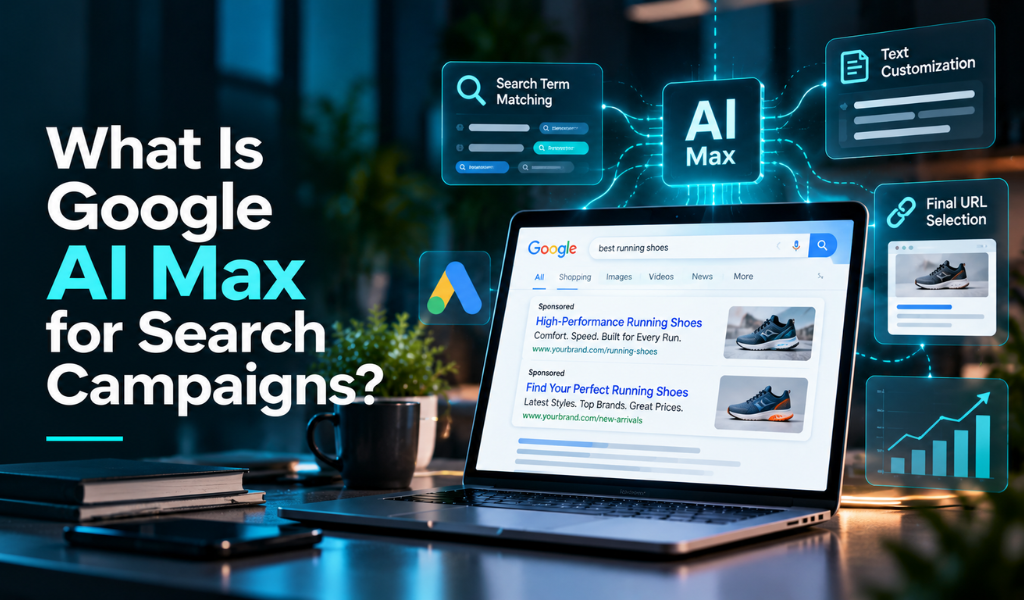
Google AI Max brings this to life in Search campaigns, complete with a host of built-in features. These include matching of search terms, text customization, and expansion of the final URL.
AI Max doesn’t just consider each keyword as an individual target, but it can also look at broader signals to find searches that may be relevant to a business.
This is especially useful for customers who use longer conversational or unexpected search queries that are difficult to predict manually.
How Does AI Max Work?
AI Max can increase search coverage using broad match, asset-based and keywordless technology. It can also draw on information from existing ads, landing pages and other campaign assets to craft advertising messages that better align with a user’s search intent.
Final URL expansion can then direct a user to a relevant page on the advertiser’s website when Google anticipates performance could be improved by sending them there.
Key Features of AI-Powered Advertising
1. Smarter Search Term Matching
Traditional keyword planning may miss out on valuable variants of searches. AI Max leverages additional signals to identify potentially relevant queries and extend reach.
This allows AI-powered advertising to work well for businesses targeting customers with changing search behavior.
2. Automated Ad Text Customisation
Leveraging data from existing ads, website content and other assets, AI Max can generate custom ad assets. The idea is to make the messaging more relevant to the individual search.
That means landing-page messaging can have an impact on the information these automated systems use, so advertisers should ensure their website content is accurate, useful and up to date.
3. Final URL Expansion
Final URL expansion can pick a more relevant page from the website instead of sending every visitor to the same landing page, when it’s likely to improve user experience and campaign performance.
This can help users discover more relevant information for their search.
Why Are Businesses Exploring AI-Driven PPC Advertising?
When you’re running multiple campaigns, reviewing every keyword, search variation, ad and landing-page combination can quickly become a time consuming task.
AI-powered PPC advertising can relieve some of this manual workload while letting Google’s systems take in a much wider variety of signals.
But it doesn't get rid of strategy. Conversion tracking, audience targeting, budgets, landing-page quality, and clear business objectives still matter.
Google recommends using AI Max with conversion-focused Smart Bidding, so the system can optimize toward meaningful business outcomes, rather than just driving more traffic.
AI Google Ads Management: What Should Businesses Consider?
Review your campaign foundations before you turn on every automated feature.
A business should have clear conversions, reliable tracking, and landing pages that accurately reflect its products or services. Negative keywords and brand controls can also continue to be important to campaign relevance. Google says negative keywords will be honored when AI Max is on
Professional AI Google Ads management lets businesses strike the right balance of automation and oversight by humans, especially when campaigns have different goals, budgets, or geographic needs.
Practical Information Table
|
|
|
|
|
|
|
|
|
|
|
|
|
|
|
|
|
|
|
|
|
|
|
|
How to Use Automated Advertising Campaigns Effectively?
Automation is most effective when it has rich information to learn from. Some practical actions you can take before adopting AI Max:
- Define valuable conversions: Track enquiries, purchases, bookings or other meaningful actions.
- Review landing pages: Make sure major services and products have easy-to-understand, helpful pages.
- Check tracking: Before enabling automated features, verify that conversion and URL tracking are functioning correctly.
- Set appropriate budgets: AI Max may require a sufficient budget to explore additional opportunities. Google notes that campaigns limited by budget may not benefit fully from AI Max.
- Monitor performance: Look at search terms, conversions, costs, and landing-page performance instead of just impressions or clicks.
Astral Digital Technologies can help businesses with automation, campaign strategy and ongoing performance monitoring to take a balanced approach to AI advertising.
Also read: How To Optimize Ecommerce Product Pages For AI Search In 2026?
Is Google AI Max Right for Every Business?
Not necessarily.
Advertisers can benefit from using AI Max for extra reach and more automated optimization, but it should support a well-planned Search strategy, not replace it.
Those with poorly configured conversion tracking, unclear goals, or weak landing pages need to address these basics first.
The best way is to test AI Max thoroughly, measure meaningful performance indicators, and fine-tune campaign settings based on real business outcomes.
Conclusion
AI advertising is making Google Search campaigns more reactive to changing customer behavior. Google AI Max combines search term matching, ad text customization, and Final URL expansion into existing Search campaigns to help businesses find more opportunities and take some manual work out of campaigns.
But successful automation still requires good strategy, accurate conversion data and relevant landing pages. With the right setup and constant optimization AI Max can be a useful cog in a modern paid search strategy.
If you are interested in exploring the potential for AI Max to support your business goals, then you might want to consider reaching out to an experienced Google Ads team such as Astral Digital Technologies for a tailored campaign assessment.
FAQs about Google AI Max Search Campaigns
1. What is Google AI Max for Search campaigns?
Google AI Max is an optimization layer within Search campaigns that uses AI to improve search term matching, ad messaging and landing-page selection.
2. Is AI Max a new Google Ads campaign type?
No. AI Max is not a separate campaign type. It works as an optimization layer within existing Google Search campaigns.
3. How does AI Max improve Google advertising?
AI Max can expand relevant search opportunities, customize ad text and direct users to relevant pages based on their search intent.
4. Does AI Max replace keywords?
Not completely. AI Max expands how Search campaigns can identify relevant queries, using technologies such as broad match and keywordless targeting alongside existing campaign signals.